







Kwanzaa Ideas

It is not a religious holiday, however, it is a time for African Americans to celebrate their heritage, their culture and take a look back at their ancestors and revel in their memories.
- Umoja (OO-MO-JAH) Unity stresses the importance of togetherness for the family and the community, which is reflected in the African saying, "I am We," or "I am because We are."
- Kujichagulia (KOO-GEE-CHA-GOO-LEE-YAH) Self-Determination requires that we define our common interests and make decisions that are in the best interest of our family and community.
- Ujima (OO-GEE-MAH) Collective Work and Responsibility reminds us of our obligation to the past, present and future, and that we have a role to play in the community, society, and world.
- Ujamaa (OO-JAH-MAH) Cooperative economics emphasizes our collective economic strength and encourages us to meet common needs through mutual support.
- Nia (NEE-YAH) Purpose encourages us to look within ourselves and to set personal goals that are beneficial to the community.
- Kuumba (KOO-OOM-BAH) Creativity makes use of our creative energies to build and maintain a strong and vibrant community.
- Imani (EE-MAH-NEE) Faith focuses on honoring the best of our traditions, draws upon the best in ourselves and helps us strive for a higher level of life for humankind, by affirming our self-worth and confidence in our ability to succeed and triumph in righteous struggle.
 Decorating the Home
Kwanzaa colors are green, black and red. When decorating your home, you should stick to things that are African in design and represent the heritage of African-American people. Mixing African art and fabric with ribbons, candles, flowers and more can pull everything together for a fantastic holiday.
The Kinara along with the other symbols of Kwanzaa should dominate the room, which should be given an African motif. This is easily achieved and shouldn't result in too much expense. The colors of Kwanzaa are black, red and green. This should be kept in mind when decorating the home. Black, red and green balloons, streamers, cloth, flowers, and African prints can be hung tastefully around the room. Original art and sculpture may be displayed as well.
 kwanzaa Table decorations and menu
The Kwanzaa Feast (or Karumu) is traditionally held on December 31st (participants celebrating New Year's Eve, should plan their Karamu early in the evening). It is a very special event as it is the one Kwanzaa event that brings us closer to our African roots. The Karamu is a communal and cooperative effort. To decorate your table, you’ll need the seven symbols of Kwanzaa—placed decoratively on the center table.
- The Kinara (candle holder) is like a menorah—holds seven candles to reflect the seven principles that are the foundation of Kwanzaa. Buy one or make one—easy enough: a piece of wood works fine; add screw-in candle holders and, voila, you have a Kinara! In fact, have the whole family create this symbol—it’s what Kwanzaa is about.
- The Mkeka (a placemat made of straw) is the foundation of the centerpiece. While straw is suggested because it is traditional, cloth makes an adequate substitute. If cloth is used, one with an African print is preferred. Place an ear of corn on the place mat to symbolize the African concept of social parenthood. The placemat is the center of the celebration—the Kinara and all items listed below should be placed upon it to create a centerpiece.
- Mazao (fruits and vegetables);
- Vibunzi (ears of corn, one for each child in your home);
- the Kikombe cha umoja (communal unity cup);
- Mishumaa saba (seven candles, one black, three red, and three green);
- and Zawadi (gifts that are enriching).
 kwanzaa activites
Ceremonies and cultural expressions are highly encouraged. It is important to decorate the place where the Karamu will be held, (e.g., home, community center, church) in an African motif that utilizes black, red, and green color scheme. A large Kwanzaa setting should dominate the room where the karamu will take place. A large Mkeka should be placed in the center of the floor where the food should be placed creatively and made accessible to all for self-service. Prior to and during the feast, an informative and entertaining program should be presented. Traditionally, the program involved welcoming, remembering, reassessment, recommitment and rejoicing, concluded by a farewell statement and a call for greater unity.
Below is a suggested format for the Karamu program, from a model by Dr. Karenga.
- Kukaribisha (Welcoming): Introductory Remarks and Recognition of Distinguished Guests and All Elders. Cultural Expression (Songs, Music, Group Dancing, Poetry, Performances, Unity Circles).
- Kuumba (Remembering): Reflections of a Man, Woman and Child. Cultural Expression
- Kuchunguza Tena Na Kutoa Ahadi Tena (Reassessment and Recommitment): Introduction of Distinguished Guest Lecturer and Short Talk.
- Kushangilla (Rejoicing)
- Tamshi la Tambiko (Libation Statement): It is tradition to pour libation in remembrance of the ancestors on all special occasions. Kwanzaa, is such an occasion, as it provides us an opportunity to reflect on our African past and American present. Water is suggested as it holds the essence of life and should be placed in a communal cup and poured in the direction of the four winds; north, south, east, and west. It should then be passed among family members and guests who may either sip from the cup or make a sipping gesture.
- Libation Statement:
-
- For The Motherland cradle of civilization.
- For the ancestors and their indomitable spirit
- For the elders from whom we can learn much.
- For our youth who represent the promise for tomorrow.
- For our people the original people.
- For our struggle and in remembrance of those who have struggled on our behalf.
- For Umoja the principle of unity which should guide us in all that we do.
- For the creator who provides all things great and small.
- Kikombe Cha Umoja (Unity Cup)
- Kutoa Majina (Calling Names of Family Ancestors and Black Heroes)
- Ngoma (Drums)
- Karamu (Feast)
- Tamshi la Tutaonana (The Farewell Statement)
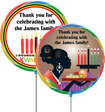
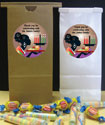
 Kwanzaa Party Favors
- African music—instruments and CDs
- Art including masks, paintings, sculptures and more
- Housewares like pillows, linens, placemats, ceramics decorated with African art
- Jewelry made in Africa or that represents African American heritage
- A "family tree" how-to for people to use to trace their ancestors
- Fashions for kids and adults
- Books on African history, art, celebrities, photo guides, travel and others
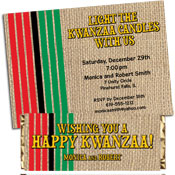
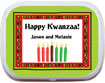
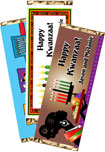
- A personalized Kwanzaa theme candy bar wrapper
Have a good time!